Beyond the Hype: How Custom ASICs are Making AI Safe and Certifiable for Autonomous Flight
The promise of Artificial Intelligence in autonomous flight is captivating. From self-navigating eVTOLs to advanced mission management systems, AI holds the potential to redefine aerospace capabilities. Yet, beneath the dazzling vision lies a profound challenge: how do we ensure these intelligent systems are not just clever, but unequivocally safe and certifiable for the most demanding environments? The answer, I believe, lies beyond generic processing, at the very heart of custom silicon.
The “Black Box” Problem and the DO-254 Mandate
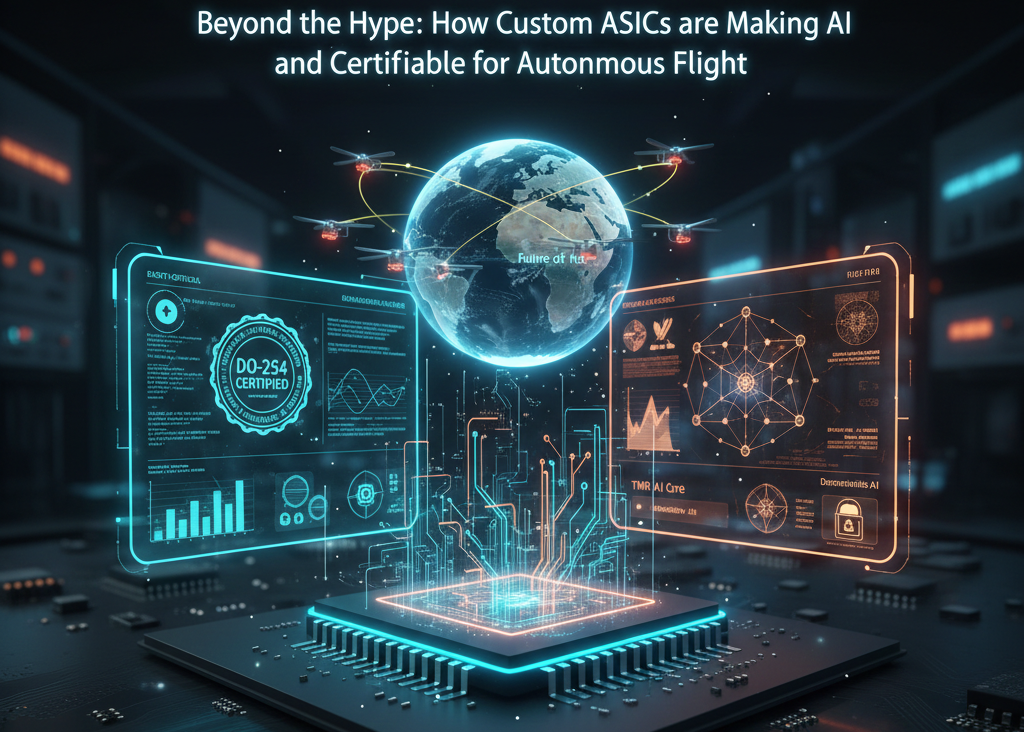
For decades, aerospace safety has been built on predictability. Every component, every line of code, every decision in a flight-critical system must be traceable, verifiable, and rigorously tested. This is the bedrock of standards like DO-254, which governs the hardware design assurance of complex electronic hardware.
The inherent nature of many advanced AI algorithms, particularly deep learning, presents a formidable “black box” problem. Their non-deterministic behavior, complex internal states, and reliance on vast, often opaque datasets make it incredibly challenging to predict their exact response in every conceivable scenario. How can one certify an algorithm that defies complete auditability, especially for Design Assurance Levels (DAL) where even the smallest anomaly can have catastrophic consequences? Attempting to force such AI onto generic processors, with their shared resources and non-guaranteed timing, only compounds the issue, introducing latency bottlenecks and further unpredictability. This fundamental disconnect between AI’s potential and aerospace’s rigorous safety requirements has long been a significant barrier to adoption.
Custom ASICs: The Silicon Key to Demystifying AI
This is precisely where custom Application-Specific Integrated Circuits (ASICs), engineered from the ground up for aerospace, become a game-changer. By moving beyond the limitations of general-purpose hardware, we can design silicon that not only executes AI with unparalleled efficiency but also embeds the critical safety and determinism required for flight certification.
My approach leverages custom ASICs to transform the AI “black box” into a “glass box” through several critical architectural innovations:
- Hardware-Native Determinism: Unlike shared-resource processors, custom ASICs allow for dedicated, optimized data paths for tensor operations. This ensures that AI inference is executed with precise, guaranteed timing, eliminating the unpredictable latency that plagues generic solutions. Every AI-driven decision becomes predictable and auditable, a non-negotiable for DAL-A systems.
- Integrated Redundancy and Triple Modular Redundancy (TMR): For missions where failure is not an option, reliability must be built into the very fabric of the silicon. We integrate TMR directly into critical functional blocks of the ASIC. This means that even if a single-event upset (SEU) or transient fault occurs in one processing lane, the redundant paths and a majority voter system ensure the correct output, safeguarding against single points of failure.
- Unrivaled TOPS/Watt Efficiency: By stripping away the overhead of generic instruction sets, custom ASICs deliver significantly higher TOPS (Tera Operations Per Second) per watt. This extreme efficiency is vital for embedded aerospace systems where power and thermal budgets are strictly limited, allowing for more advanced AI to be deployed on smaller, lighter platforms.
- Silicon-Level Auditability: Our ASICs incorporate hardware-based monitoring and diagnostic circuits that provide real-time validation of AI outputs. This built-in transparency allows for continuous self-assessment and compliance verification, giving certifiers the irrefutable evidence they need.
Paving the Way for Truly Autonomous Flight
The implications of this approach are profound. Custom ASICs are not merely about faster calculations; they are about enabling trustworthy AI for applications previously deemed too risky. This includes:
- Certified Autonomous Navigation: AI systems that can reliably perceive, plan, and execute flight paths with deterministic precision.
- Intelligent Mission Management: Hardware capable of making real-time, certifiable decisions in complex, dynamic operational environments.
- Robust Sense-and-Avoid Systems: AI for object detection and collision avoidance with built-in fault tolerance, crucial for unmanned aerial systems.
- Enhanced Fault Diagnostics: Predictive maintenance driven by AI, with the underlying hardware ensuring the integrity of diagnostic inferences.
The future of autonomous flight will be defined not just by what AI can do, but by what AI is permitted to do. My work in custom ASIC design ensures that the intelligence embedded in our aircraft is not only cutting-edge but also inherently safe, certifiable, and capable of meeting the rigorous demands of the aerospace industry.
Ready to Integrate Trustworthy AI into Your Next-Gen Platform?
As we move forward, the strategic choice of hardware will be the defining factor in unlocking AI’s full potential in the skies. To learn more about how custom ASICs can transform your aerospace projects, explore my research publications or contact me directly to discuss your specific needs. The future of flight is indeed in the silicon.