
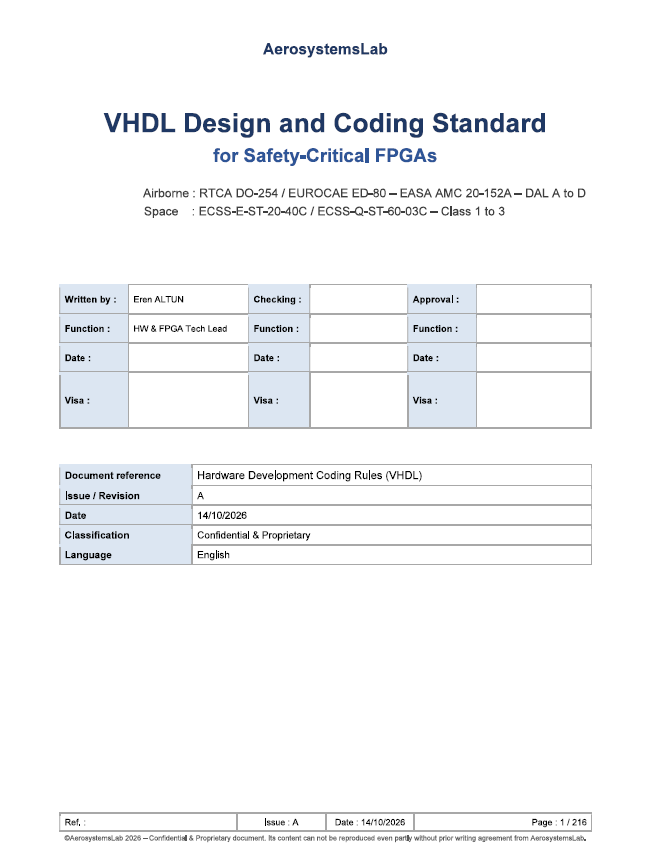
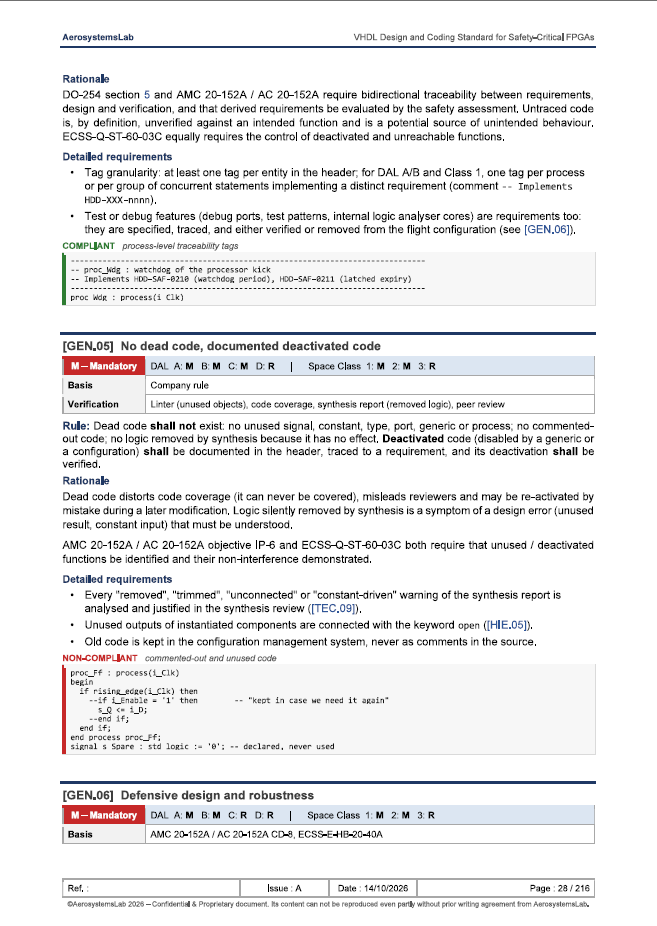
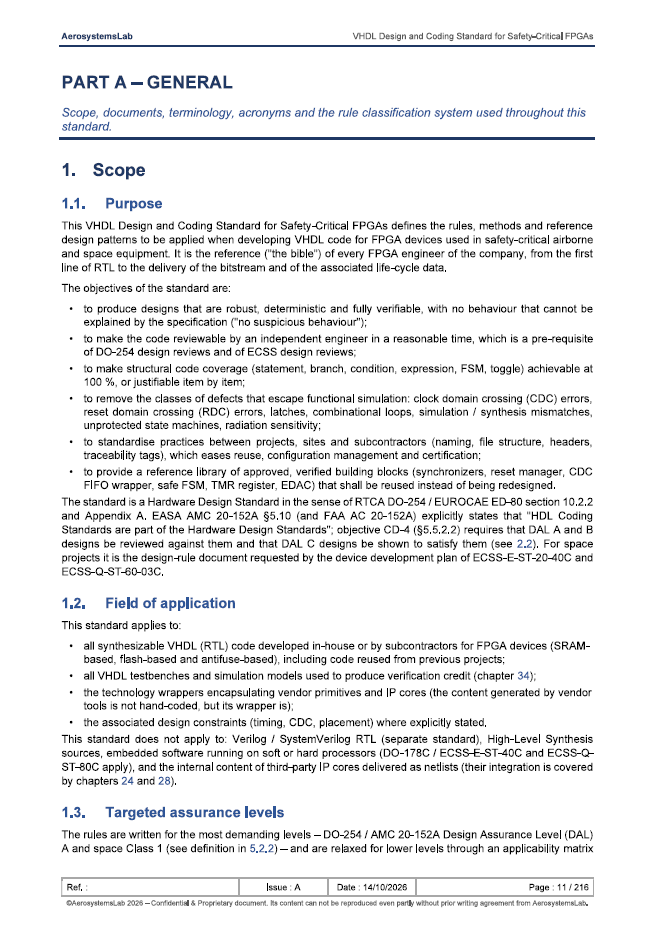
VHDL Design and Coding Standard for Safety-Critical FPGAs
A practical VHDL design guide for safety-critical FPGA development, covering coding rules, synchronous design, reset handling, clock domain crossing (CDC), FSMs, and code coverage. Based on engineering experience and aligned with DO-254, AMC 20-152A, and applicable ECSS practices, it provides ready-to-use code examples and technical rationales to help FPGA teams develop robust, verifiable, and maintainable designs. (230 pages)
Contact me for more information on purchasing this document.
Description
VHDL Design Rules for Safety-Critical FPGA Development — DO-254 & ECSS
A Practical Engineering Guide to Robust, Verifiable and Certification-Oriented VHDL Design
Product Description
Developed from practical engineering experience and lessons learned from safety-critical projects, this document provides a structured set of VHDL coding rules and design best practices for FPGA development in aerospace and other safety-critical applications.
Aligned with the objectives of RTCA DO-254 (ED-80), AMC 20-152A and applicable ECSS engineering practices, this guide aims to help FPGA engineers establish consistent coding standards, improve design predictability, and facilitate verification, review, and certification activities.
Rather than focusing solely on coding style, the document explains the engineering rationale behind each rule, helping teams understand how coding decisions influence hardware behavior, verification complexity, and design assurance.
Each rule is supported by practical guidance and ready-to-use code examples, making the document a hands-on reference for FPGA designers, technical leads, hardware architects, and verification engineers.
What’s Inside
- Naming Conventions: Systematic prefixes for inputs, outputs, signals, constants, generics, instances, and processes to improve readability, consistency, and automated coding-rule checks.
- Synchronous Design Principles: A disciplined coding approach intended to improve predictable hardware behavior and facilitate verification.
- Reset Handling: Guidelines for reset synchronization and release management within clock domains to mitigate metastability risks.
- Clock Domain Crossing (CDC): Design rules for safe data transfers between asynchronous clock domains, including the use of instantiated BRAM-based FIFOs where appropriate.
- Finite State Machines (FSMs) and Code Coverage: Structured FSM implementation practices designed to improve traceability, testability, and coverage analysis while minimizing unreachable or redundant logic.
- Pre-Review Checklist: A practical checklist to apply before code reviews to identify potential design issues and enforce consistent coding practices.
Key Benefits for FPGA Engineering Teams
Improved Design Robustness
Promote consistent coding practices that help prevent common implementation issues, including unintended latches, reset-related hazards, and unsafe clock domain crossings.
More Efficient Code Reviews
Establish a common coding framework that enables reviewers to focus on functional correctness, design intent, and potential hardware risks rather than inconsistent coding styles.
Simplified Verification and Coverage Closure
Encourage clear, testable implementations that facilitate verification planning, coverage analysis, and the investigation of uncovered or unreachable code.
Documented and Defensible Engineering Decisions
Provide technical rationales for coding rules to support design reviews, verification activities, and engineering discussions during audits.
Consistent Development Practices
Give new team members a practical reference that helps them adopt established coding conventions and design practices from the beginning of a project.
Why Different VHDL Coding Rules for Safety-Critical Systems?
In avionics, VHDL is not simply a programming language. It describes hardware whose behavior must be predictable, verifiable, and supported by objective evidence.
Under DO-254 and the associated guidance applicable to airborne electronic hardware, development teams must demonstrate that the implemented hardware satisfies its requirements and that the design assurance activities are appropriate to the applicable Design Assurance Level (DAL).
Many implementation issues originate not from the underlying algorithm, but from coding decisions: incomplete assignments that infer latches, poorly managed reset deassertion, or unsafe data transfers between clock domains.
These issues can remain undetected during simulation and emerge later during hardware integration or testing.
This guide addresses such challenges through a set of explicit coding rules, practical examples, and engineering rationales designed to encourage disciplined development practices for safety-critical FPGA designs.
Who Is This Guide For?
- FPGA and VHDL Design Engineers
- Senior FPGA Engineers and Technical Leads
- Hardware Architects
- FPGA Verification and Validation Engineers
- Design Assurance and Certification Engineers
- Aerospace and safety-critical electronics engineering teams
Intended Use
This document can be used as a reference for defining or improving internal VHDL coding standards, supporting design reviews, guiding FPGA implementation practices, and contributing to project-specific development and verification processes.
It is intended to complement, not replace, applicable standards, project requirements, approved development processes, and formal verification and certification activities.
Deliverable: A technical reference document containing VHDL design rules, coding examples, engineering rationales, and a pre-review checklist.
Important note: This guide is an engineering reference. Compliance with DO-254, AMC 20-152A, or applicable ECSS standards depends on the specific project context, the applicable requirements, the approved processes, and the supporting verification and design assurance evidence. The document does not constitute certification approval or guarantee certification.


Reviews
There are no reviews yet.